
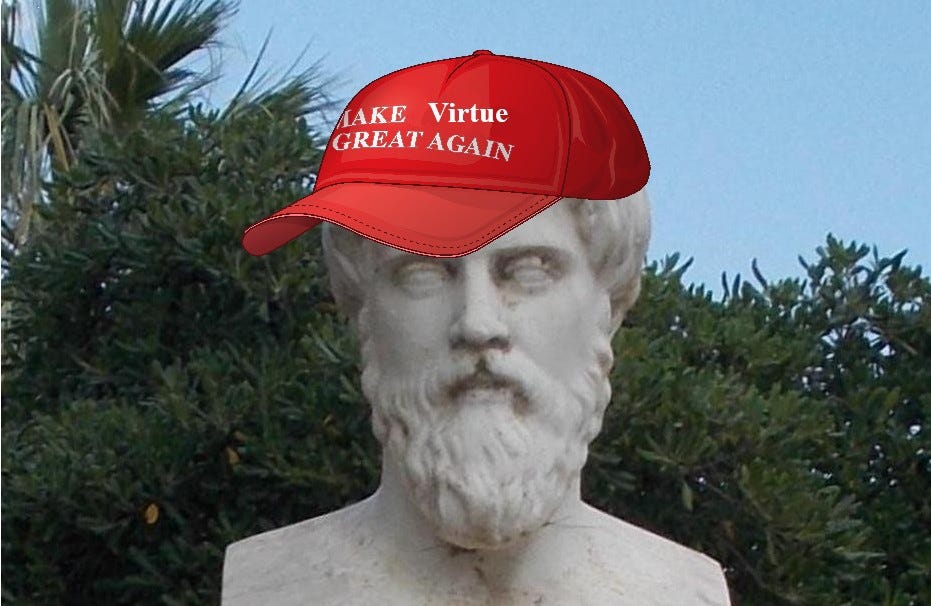
This is part of a larger series I am working on.
The ancient Greco-Roman Plutarch’s Parallel Lives is a timeless work that details the biographies of some of the most prominent figures in the Greek and Roman world. He believed that his biographies could provide moralistic examples of how to lead one’s life. He emphasized virtue and forthrightness in public policy, both by individual leaders and the collective communities they led.
The book is immensely important for the United States because many of the Founders revered Plutarch’s work and it provided the basis for their own ideas about morality and its role in government and public life. Morality and virtue were in many ways the last guardrails that the Framers envisioned for the Constitution and American republican government. When Benjamin Franklin supposedly told the people of Philadelphia that they had created “a republic, if you can keep it,” Plutarch’s Parallel Lives is the cheat sheet from which he hoped Americans would draw from.
Plutarch’s Lives is especially important in the context of military theory because war is the most morally complex action a society can undertake. How it thinks about, conducts, and responds to war takes off any mask a society wears. It reveals all the good, the bad, and the ugly of a people, and we often do not like what we find.
Plutarch very well might have written his Lives in an attempt to save Rome from itself as it descended into the imperial madness of Nero and Caligula. In that sense, it can also help America reflect on itself and avoid Rome’s fate.
For Plutarch, Greek public life had followed a clear narrative arc. Coming out of a possibly mythical past, the various Greek city-states had, over the course of centuries, come to flourish in the eastern Mediterranean, but were not a unified group. Various cities showed extreme promise: Athens for intellect and her navy, Sparta for prudence and her discipline, Thebes for her distaste of despotism, but they never really pulled together. One gets the sense that Plutarch believed a unified Greece would have been responsible for remarkable things.
Instead, Greece faced a series of external threats that were always able to take advantage of Greece’s division. In the Greco-Persian War, an alliance of Greeks led by virtuous men like Aristides and defeated Persia’s invading forces, but the allied Greeks faced off against just as many Greeks that had remained neutral or sided with the advancing Persians. Later, during the Peloponnesian War, Greece waged an epic Greek on Greek conflict, with Persia always happy to fund and interfere with one of the various contesting parties. Persia wanted Greece disunited and paid good money to keep men like Agesilaus distracted with their limited hegemonies.
Eventually, a Macedonian army descended on Greece from the north and conquered it, and however much Phillip II and Alexander might have also spoken Greek, the Greeks themselves did not consider them Greek. Consequently, though Alexander conquered vast territories and created a large Hellenized world across the eastern Mediterranean and western and central Asia, this was not really an accomplishment of the Greeks themselves, something the later Greek Plutarch seems self-conscious about.
With Alexander’s death, Greece, along with the rest of Alexander’s former empire descended into centuries of conflict among the various successor powers, all speaking Greek, none of them Greek, and often treating Greece itself as just another bargaining chip. Eventually, this constant instability attracted the attention of a new power in the west, the Roman republic, because of people like Pyrrhus. Roman leaders became increasingly involved in Greek affairs and “liberated” Greece from the Macedonian tyrants.
Conquered by Rome, Greece was able to finally enjoy centuries of stability and relative peace, and Roman military action moved farther north and east over the years. However Greek culture was always subordinated to Latin culture, however much many Romans might have personally admired Greek culture and learning.
Despite the lengthy list of enemies and conquerors Greece faced over the years, Plutarch clearly sees the Greeks as the greatest enemy of the Greeks. He identifies nations as suffering collectively from the same sorts of vices that individual people can. For Plutarch, the constant angling of Greece’s various cities to be the leader of a Greek hegemony and the inability to subordinate collective profit for individual greed, was why Greece never flourished as much as it might have. Lured by the vices and temptations of outsiders looking to take advantage of them, the Greeks were conquered repeatedly.
In writing his Parallel Lives, Plutarch also held up a mirror to his current nation: Rome. He viewed the rise and fall of Greece as a similar story arc to that of the Roman republic and its collapse into the Principate and imperial dynasties that followed. Plutarch lived through the Year of the Four Emperors, and one imagines he hoped his work could act as a cautionary tale and encourage civic and governmental reform.
Plutarch was less sold on Rome’s mythological origins and moved quickly past its more supernatural aspects to discuss a Rome that can be documented. He is critical of Romulus’ homicidal and tyrannical excesses and holds up Numa and Poplicola as far better models of leadership to emulate.
He seems to believe that the Punic Wars were Rome’s equivalent of the Greco-Persian War: an existential conflict that also gifted the victors with an unintended empire. However, like the Greek city-states two hundred years before, how Rome handled its empire was the real test of the nation and its citizens’ character. Would the Romans, unlike the Greeks before them, hold fast to their virtuous customs and beliefs, or would the wealth of imperial control encourage them to succumb to infighting in the purist of crass profit and power?
In Plutarch’s mind, the Romans had utterly failed that test. Romans like Marius and Sulla fought over who would control the leading factions in the Senate. The financial excesses of hyper wealthy individuals like Crassus caused strife and discontent among the increasing ranks of poor Romans. Individuals like the Gracchi brothers tried to ameliorate these disparities but they became slaves to the mob and in turn caused the wealthy senatorial class to entrench their power even further.
Decades of permanent war threw the traditional Roman military system on its head. Soldiers before had served one or two years at a time. Endless campaigning on the far edges of the empire in pursuit of various Senators’ vanity caused permanent armies to creep in, armies that received their pay directly from their senatorial generals rather than the state. It was not long before those senators were demanding the soldiers be loyal to them personally and not to the ideals of the republic and the senate and people of Rome.
Like the Greek world following their first war with Persia, in which each city jockeyed to be the imperial hegemon, the various interest groups and powerful individuals in Rome fought with each other over who would lead the “republic”, which was increasingly becoming a shell of its former self. Eventually the system buckled under the strain, with the chaos of the fight between the Senate and Julius Caesar opening the way for an even more destructive contest between Octavian and Marc Antony after Caesar’s murder.
By the end of that conflict, Octavian had become Augustus and installed effective one-man rule of the empire, wielding vast powers over a neutered senate. For Rome, the final tragedy was, arguably, Augustus’ effectiveness as a leader. He was a competent figure who reigned for 15 years and acculturated Romans to the new system. His successors were a different story, but by then the senate was essentially defunct and in no position to reassert its authority. Rome was stuck with the mercurialness of one-man rule.
In presenting dozens of biographies of famous political and military leaders of the Greek and Roman world, Plutarch also has a lot to say about military theory over the course of roughly six hundred years.
Both the Greeks and the Romans began with similar styles of armies and concepts of warfare with limited organization, limited scope to conflicts, and limited capacity to conduct them. These affairs tended to be with a city’s nearest neighbors over the borders of arable land in the countryside fought by each city’s militia force that assembled for the battle and then went home. Eventually, some Greek cities and Rome came to innovate in numerous ways that changed these early norms.
The Spartans used their subjugation and enslavement of their neighbors to provide the resources with which they could focus on outfitting and training their male citizens into fulltime warriors. The average Spartan was regularly able to out fight his foreign peers through a focus on physical conditioning and individual prowess. However, the Spartans exhibited little innovation at any collective level of warfare. They were great warriors, but that is it.
Athens came to rely on her navy and the operational and strategic advantages it provided. The average Athenian would struggle on the battlefield with their Spartan equivalent, so they found ways to not have to fight them there. Athens’ fleet helped it develop a vast Aegean empire, which gave her funds she could use to further build out her fleet. For most of the Peloponnesian War she kept the Spartans on their back feet by utilizing an indirect approach, isolating and defeating in detail individual Spartan garrisons through amphibious warfare and avoiding set piece land battles. Only when Athens abandoned its successful model and when Sparta finally adopted something similar to the original Athenian plan, did Athens fall.
Rome started out with a democratic citizen-soldier militia similar to Athens.’ However, Rome did not have the same ability to avoid land engagements as Athens. Accordingly, she developed a system of command and control that emphasized flexibility on the battlefield. Traditional armies were cumbersome masses of one long unbroken line. An ingenious commander, like an Alexander, might develop a creative arrangement of forces for the terrain at hand, but once their army started to advance, there was little the commander could do to alter the plan. They took a position where they thought their personal influence could be of most use and then fought alongside their soldiers.
However, under the Roman system, generals became battlefield managers, not just a warrior turned war leader. The Romans used complicated systems of musical commands and staff officers to enable actual maneuver elements on the battlefield that could be held in reserve and feed into where they would be most efficacious. The battlefield became more of a chess match than a rugby scrum.
Plutarch’s Lives also explores other methods of warfare than just the direct approach favored by a Marius or a Caesar. In the Second Punic War, Fabius chose to avoid battle with Hannibal in order to wear down his Carthaginian opponent’s army which was lethal on the battlefield but also regularly short of supplies. Because of the Punic War’s, Rome developed a vast navy capable of adopting indirect strategies like the Athenians had, and indeed Pompey argued that that would have actually been the best way to deal with his rival Caesar, who had a large well trained army in Italy but that needed to be feed from external supply centers. His fellow senators overruled him, and Caesar defeated Pompey at Pharsalus. We even get investigations of guerilla warfare and counterinsurgency in the biographies of Romans like Sertorius and Caesar.
Indeed, one might expect Plutarch to favor the “Great Men” who won big battles on the battlefield, but he often saved his most effusive praise for leaders who bucked traditional approaches to find creative methods to solve complicated problems. He also valued leaders who minimized the costs of war in both treasure and ,especially, in blood, both the blood of their soldiers, their opponents, and civilians. For Plutarch, there was no wishing away that wars would happen, but he believed that part of a military or political leaders’ ethical responsibility was to minimize its negative impacts.
Plutarch’s Lives is the story of various men, but, in many ways, the men are stand ins for the societies that created them. As much as many of these men shaped their societies and worlds in immense ways, their societies shaped and created them even more so. None of Plutarch’s subjects had to be the way they were from birth. Their societies’ natures nurtured them, for good and for bad.
Plutarch emphasized time and again the need for virtue, frugality, and grace, especially in public life, and especially from the collective society. He had watched Rome descend into madness and hoped to turn it back. He might have failed in that effort in his own time, but there’s no reason his work cannot have more effect on ours, just as America’s founders hoped it would.
 The History Doctor
Leave a comment