
This is part of a larger project I am working on. These are just raw reactions to the text as I read it. For the final discussion, check out my Substack.
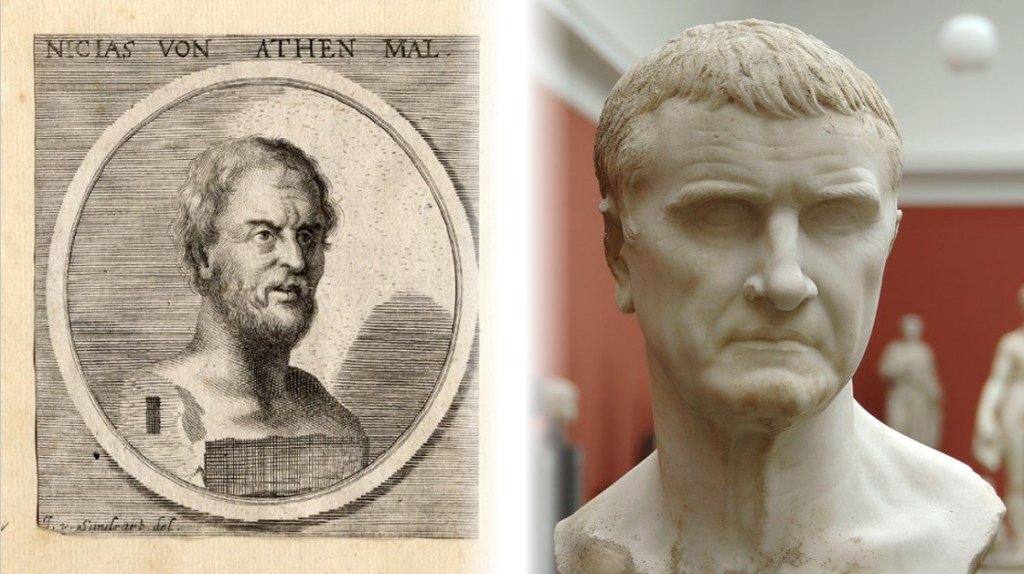
Nicias and Crassus were the victims of imperial overreach, at times when both Athens and Rome felt they could not fail at anything they tried.
Nicias was an Athenian leader who was associated with the more aristocratic faction. He was a humble man known for his virtue. In the first phases of the Peloponnesian War, he had immense success and had numerous victories around the western Aegean, including the capture of the island Cytherea, off the Spartan coast. He was largely an ideological successor to Pericles in terms of both politics and military strategy, believing that Athens should stay on the strategic defensive throughout its conflict with Sparta and not take on new adventures or attempt to expand the empire.
With the first phase of the conflict going well for Athens, Nicias helped negotiate peace between the two rival cities, the eponymously named “Peace of Nicias“. It is unclear if Nicias believed this would be a lasting peace, but he quite clearly liked the idea of giving Athens as long a break as possible from the expensive war the city had been fighting.
Others, most famously Alcibiades, disagreed and wanted to keep the pressure on the Spartans. They argued for an invasion of Sicily, with the idea that the island could be a jumping off point for attacks on Italy and north Africa. Their idea was that Sparta was at a low point, so better to expand the Athenian empire and use those newfound resources to crush Sparta while Athens had the chance.
The people of Athens agreed with Alcibiades but put Nicias in charge of the expedition to Sicily because of his military experience and because he was a more cautious commander, they felt that Nicias could act as a veto on the ground and be trusted like a modern quarterback to make an audible at the line of scrimmage. This was a disastrous decision. Nicias clearly did not believe in the mission, and, having been overruled once already by the Athenian assembly, did not really feel comfortable aborting the operation he had been ordered to undergo.
The result was a catastrophe for Athens, The Athenian expeditionary force did not act with initiative upon its arrival in Sicily, wasting its operational and tactical surprise. The Athenians did not actually have the resources they needed because of faulty prior intelligence and so struggled to get inland when they did finally strike. The Sicilians bottled up the Athenians outside Syracuse, and, when Athens sent reinforcements, those forces only became more troops that would be killed by or surrender to the Peloponnesian-backed soldiers on the island. Nicias died leading his soldiers on a desperate overland evacuation, trying to find any friendly ships that could get them home.
Crassus was born into a respected, but still plebian family, in Rome. When Marius stormed Rome following his feud with Sulla, almost all of Sulla’s family was killed by Marius’ forces. He fled to north Africa and bided his time until Sulla returned to Italy. Crassus then joined Sulla’s army and fought alongside Pompey, both competing for Sulla’s favor.
When Spartacus led an insurrection of enslaved gladiators, Sulla commanded the army that nearly destroyed Spartacus’ army. That “nearly” part was important because Pompey was called back from Spain with his legions to help and showed up at the very end of the campaign, denying Sulla all of the glory. Glory for the operations against Spartacus was in short supply because, as far as the Senate and people of Rome were concerned, the war was “only” against slaves and an internal police action. Therefore, Sulla received no major honors for being the victorious general.
Despite his rivalry with Pompey, Crassus allied with him and Caesar as the popular faction against the senatorial faction, led by Cato and Cicero. With the “First Triumvirate” formed, Caesar stayed military leader in Gaul, while Pompey commanded Spain and Crassus Syria. The last two drawing lots for their provinces.
Drawing Syria was ostensibly lucky for Crassus, as it was the more attractive command with room for the Roman empire to expand east. Crassus had the exploits of Alexander in mind, planning to strike down the Tigris and Euphrates rivers against the Parthians, maybe getting all the way to India like history’s most famous Macedonian had done.
The expedition was a disaster. The Parthians drew Crassus further and further into modern day Iraq and away from his allies in the mountains of Armenia to the north. The Parthian objective was to draw Crassus’ army of heavy infantry into the open terrain of the desert where the Parthians could make maximum use of their primarily cavalry army. If Crassus had read his Xenophon, he might have guessed what the Parthians were up to. As it was, he had his infantry hunker down in tight “testudo” formations, assuming the Parthians would eventually run out of ammunition. Poor Roman intelligence failed to reveal the existence of a large Parthian supply of arrows in a baggage train designed for that express purpose. Crassus’ army war worn down and killed, himself included. It was one of the worst defeats in Roman military history, with multiple legions wiped out and their standards captured. While captured flags and standards were important in later military history, for the Romans, their legionary standards were religiously worshiped. The defeat of such a large army implied the gods themselves were angry at Rome.
Both Nicias and Crassus were victims of imperial overreach. Riding a string of victories and with military systems that had been extraordinarily successful thus far, the invasions of Sicily and Parthia maybe seemed like promising ideas. However, the leaders involved did not accurately assess the new contemplated campaigns and failed to realize how these operations were different than previous successes. Athens did not traditionally do extended land operations, its strength was at sea and in the amphibious domain. For Rome, her highly disciplined army had been custom built to deal with “barbarian” infantry forces that did not have the tactical prowess that the Romans had developed. They were not equipped to deal with large clouds of highly mobile enemies using hit and run tactics. You get the war you have, not the one you want, and in the case of Sicily and Parthia, the other side chose not to fight the way the Athenians or the Romans wanted.
If you’re interested in the final discussion of the book, check out my Substack.
 The History Doctor
Leave a comment