
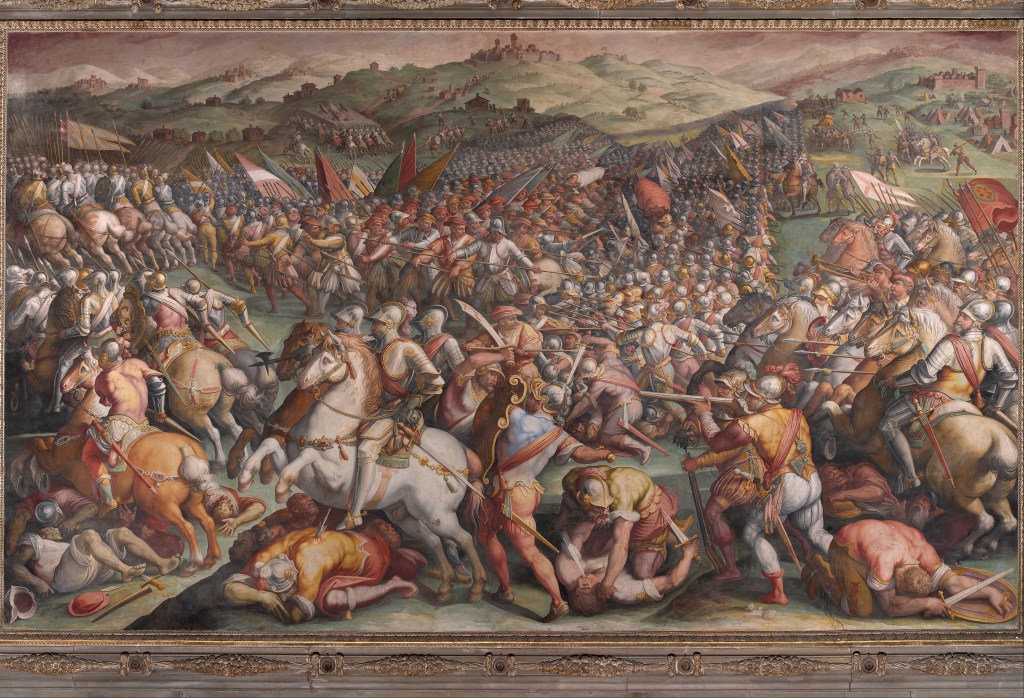
This is part of a larger series I am working on.
Nicolo Machiavelli is the now much maligned author of The Prince, a book he wrote to try and get into the good graces of the scheming Medici family that had taken over Machiavelli’s native Florence. However, in the centuries immediately following his death, two other of his books, Discourses on Livy and The Art of War were far more influential, The Prince being suppressed across much of Europe lest a king’s subjects learn some dirty truths about hard power and get ideas of their own.
Taken together, these books are a top to bottom examination of the purpose, development, and application of foreign relations and military affairs from the level of the king or president all the way down to the individual soldier. The Prince focuses on policy at the level of a head of state, Discourses on Livy takes us down to the level of strategy and operations, and The Art of War is where we hear the ring of battle and understand how the fight of individual combatants (ideally) aides the Sovereign and are themselves enabled to win because of decisions made by the Sovereign long before the battle started.
Machiavelli’s corpus remains critical for anyone concerned about politics, military affairs, and civilian policing. The last might seem out of place, but the police, whether national, state, or local represent the armed power of the state and are a source of possible insurrection to the state and its Sovereign.
The most important thing that Machiavelli stresses repeatedly throughout his books is that the civilian government must have complete control over the armed power of the state. Whether the civilian government is a king in a monarchy or the people in a republic, the non-military leaders of the polity must have the absolute deference of the army.
He emphasizes civilian control of the military because, to be an effective ruler, the sovereign must have no equal. In his day, this was because the Italian city-states had been burned time and again by mercenary warband leaders who sold the services of their soldiers to the highest bidder, but in modern times think of some local American police forces (the armed power of the local state) that have occasionally gotten too entitled. The mayor of a city is the democratically elected official placed in charge by the citizens (the sovereign power) of that city. If the police force doesn’t like their fellow citizen’s choice, they shouldn’t be able to “blue flu” or threaten laxer enforcement of laws.
Were it up to Machiavelli, these police wouldn’t be defunded, they would be run out of town by a newly formed, loyal, citizen-militia and treated like their Italian mercenary forebearers. The sovereign’s authority to command the armed power of the state, the first and most important power, cannot be questioned, or else you have an unstable state.
For the sovereign to competently oversee the military, he or she must be knowledgeable of military affairs. Whether an heir preparing to become king or citizens that want to enter a career in government, they must be curious about and study the use of force.
This does not mean that only Americans that have been in the military should serve in elected office, though Machiavelli has some thoughts on that below, but rather people that want to enter elected office should be prepared enough to oversee and direct the actions of the military. The governmental use of force exists to further a policy goal of the sovereign, and the sovereign has an obligation to know what they want done and understand the realistic ability for the use of force to further those policy goals.
A lawmaker doesn’t have to attain a U.S. Army Expert Infantry Badge or an Air Force Distinguished Flying Cross, but they do need to read political and military history and understand the theories of armed conflict. A local mayoral candidate needs to read high-level theory on policing and public safety, not best practices for engaging a suspect during a traffic stop gone bad or how to execute a high-speed pursuit. They need to know enough to competently engage with their military or police technical advisors. They need to know enough to feel confident telling the armed powers of the state “no.”
This gets to Machiavelli’s last point on the topic of civilian control: political ends must never be subordinated to military means. The political goals of the state and its sovereign tell the military what it wants done, and it’s the military’s job to figure out how to do it. The military does not get to say what it wants to do, and then the sovereign begrudgingly goes along. “But what if the president or the mayor is a hippie lefty peacenik doofus?!”, Machiavelli and I hear someone screaming. Well, one, that’s why we emphasized competence above. The sovereign needs to be competent and well educated on these affairs so that they can be confident to direct, and the armed power of the state can be confident in being led. If the military or police can veto or overly coerce the actions of the sovereign, then guess what kids? The military is the sovereign. Enjoy!
Machiavelli’s next way to create a stable state and ensure its stability is to look at who serves as the armed power of the state. Here he is unequivocal: any state, but especially republics, should have citizen-soldier armies and not mercenaries. There are two main reasons for this. Mercenary armies are just there for a paycheck; they are motivated by nothing else. They don’t care about you, your city, or your state. The same goes if you are inviting soldiers from another country to protect you. You need to base your defense on your own citizens.
Your citizens also need to take an active part in their own defense. They should not outsource it to a subclass of the body politic. Not only does this put them in danger of being overthrown by the group that is armed, but it’s not fair to the armed because they have a bad sovereign. A civilian population divorced from the burden of conflict is less likely to stop needless wars and the waste of soldier’s lives. Both sides become alienated from each other, and the military or police grow to resent the unarmed population that keeps wasting their lives.
At this point we need to really examine what Machiavelli means by mercenary. He is not just talking about them in the modern sense of professional military contractors but would also include, in many ways, the modern All Volunteer Force U.S. military. Today, only 6% of Americans have served in the military. Most Americans barely know someone that served. How can they be expected to understand the actual costs and burdens of war when they aren’t sharing it and hardly know someone who is.
Even worse is state and local law enforcement. There the numbers are even worse, with only 0.2-0.3% of the population sharing the burden of securing the state. The dangers of farming out these duties and the consequent entitled mercenary attitude that can occur are more apparent atthe state and local law enforcement level where norms of civil-military relations were less entrenched in the first place. It is at this level where we can see why the fears about a standing army tax farming for its own existence off of a subordinated population kept people like Thomas Jefferson and James Madison up at night, because, in the Founders day, the police and military were often one and the same.
Machiavelli would also be furious at his European descendants these days. NATO might make sense as a collective defense policy, but the European laxity in sharing the burden has, not surprisingly, made them pawns in American politics. He wouldn’t for a moment begrudge the Americans for assembling the Postwar system the way they have. It makes complete sense for it to have assembled a collection of weaker neighbors as a buffer space between it and its near-peer adversary, Russia. However, Nicolo would have some not nice things to say to a unified Italy that turned around and forgot what it was like to be at the whims of a foreign sovereign, one that, in this case, doesn’t even dress as well as Charles VIII of France.
Citizens must be willing to take part in their own defense if they want to keep their liberties, whether that is sharing the burden of military service through a reserve system or having residency requirements for state or local police.
Machiavelli also believed citizen-soldier armies were more effective than mere mercenaries because they had more skin in the game. They had an actual cause to fight for more than just money. Money is only useful if you live to spend it. Freedom for your family and friends might be taken away if you don’t die for it.
In his works, he explores how, time and again, the citizen-soldier armies of the Roman republic were able to face stunning defeats and still assemble a new force to send against the enemy. They also tended to be more willing to take on more dangerous actions, if they believed those actions would serve a greater good.
A striking more modern example would be the American War of Independence, where numerous German and British officers were amazed by the staying power of the American Continental Army that was often not paid and at times barely fed. Most German and British soldiers, serving out a contract with the king, would have deserted long before (and been considered fairly justified in doing so). The American citizen-soldier army, like the French Revolutionary army that succeeded it, was a nationalist force fighting for more than just a contract.
These “infantry armies”, as Machiavelli calls them, stood in contrast to the Medieval armies that had succeeded them from Roman times. European Medieval battlefields had often been dominated by a knightly feudal elite who cost a lot to train and maintain. Consequently, sovereigns were loath to risk decisive battle and gut their national defense all in one go, as happened famously to the French at Crecy, Orléans, and Agincourt.
First, Machiavelli didn’t trust the feudal system because it was too risky for the sovereign to have so many near-peer sources of possible dissent and intrigue. More importantly, on the battlefield, he believed that mass would always defeat specialization if the mass was motivated and even reasonably trained.
One of the frequent critiques of Machiavelli is his focus on the past and skepticism of technological innovation, especially his seeming dismissal of gunpowder weapons. However, this misreads Machiavelli and not seeing the forest through the trees. Indeed, he is making an argument for first principals rather than magic bullets. Innovation is great, so long as it serves the actual political, strategic, operational, and tactical goals. Innovation must not wag the tail of the dog.
For Machiavelli, Big Kid War requires large (infantry) armies, not elite specialists (knights) because mass outlasts smaller specialized forces. He would be extraordinarily skeptical on the American emphasis (obsession?) with special operators since the GWOT, and the new rush to adopt technology en masse which has only made a military appearance in very specific contexts or doesn’t even have a clear end use for warfare.
The final main theme that runs through Machiavelli’s works is what the point of all the trouble raising, training, and equipping an army was about: decisive battle. While he spends a great deal of time discussing intelligence gathering, espionage, counterespionage, approach marches, etc., it all comes down to the big day. On that day, all of the years of policy developing your army and alliances, all of the months spent crafting a plan of action and strategy to defeat the enemy, all of the weeks spent marching to out-maneuver your opponent and put them in a bad position comes down to the few hours you have to close with and destroy the other army.
This is where people misread most what, many believe, is a tactical obsession by Machiavelli, the dozens of pages he spends discussing armor, weapons, and troop formations. It’s not that he really thought that because you can only find a 10’ pike and not an 11’ pike, you’re doomed. It’s that he was trying to emphasize to his readers it’s possible to do everything right in preparation and still botch the execution. A good leader needs to be ready for that final, decisive, moment.
To that end, Machiavelli generally favors and recommends the offensive, especially if you are the weaker side. This might sound counterintuitive, but his reasoning was that the weaker party cannot afford to wait to have that decisive battle. It needs to strike hard and fast so that it can knock its opponent out quickly. A stronger power can afford to stay on the defensive and prepare more shaping operations or hold out for a time that is most convenient for it, but it will eventually need to bring on the decisive engagement of the conflict.
When that day comes, everyone, from the commander to the individual soldier, needs to understand that unexpected things will happen. Fortuna, which Machiavelli compares almost to a god, will have her say. Sometimes it will be bad things, and we need to be mentally prepared to deal with them as they occur. Sometimes it will be good things, and we need to have the intelligence and initiative to take advantage of them. For Machiavelli, that’s where all the training of the citizen-soldier army now comes into play.
The Republican Roman army had a Virtù to it that enabled success. This virtue wasn’t about moral standards in the way people would think about it now but a level of competence, confidence, and cognition that allowed soldiers, even without the explicit orders of their leaders, to act, because they knew what needed to be done and didn’t need to wait to be told. This could only be acquired through robust training and the embrace of a citizen-soldier army that cared enough to take risks. This stands in sharp contrast to the contract armies of more centralized and despotic governments that downplay initiative out of fear of losing control.
Machiavelli’s works are a powerful reflection on military thought from the highest levels of political policy to the actions of an individual soldier. They emphasize that for a state to be successful, it must attempt to maintain a coherence of direction from top to bottom in making sure that its policies, strategies, operations, and tactics are all pulling towards the same ends.
Now known mostly for a ruthless approach to governance, it is best to understand Machiavelli’s …openness… to amoral actions as someone that had witnessed firsthand what happened when leaders felt they were too good to get in the mud: you lost, and the people that were willing to do the bad thing ended up in charge. Saint Augustine might have been comfortable focusing on the City of God and not worrying about the City of Man, but Machiavelli understood that, in the living world, avoiding being ruled by the devil meant at times playing the part of a demon. This was fine, so long as it was in the service of the republic or the principality.
 The History Doctor
Leave a comment