
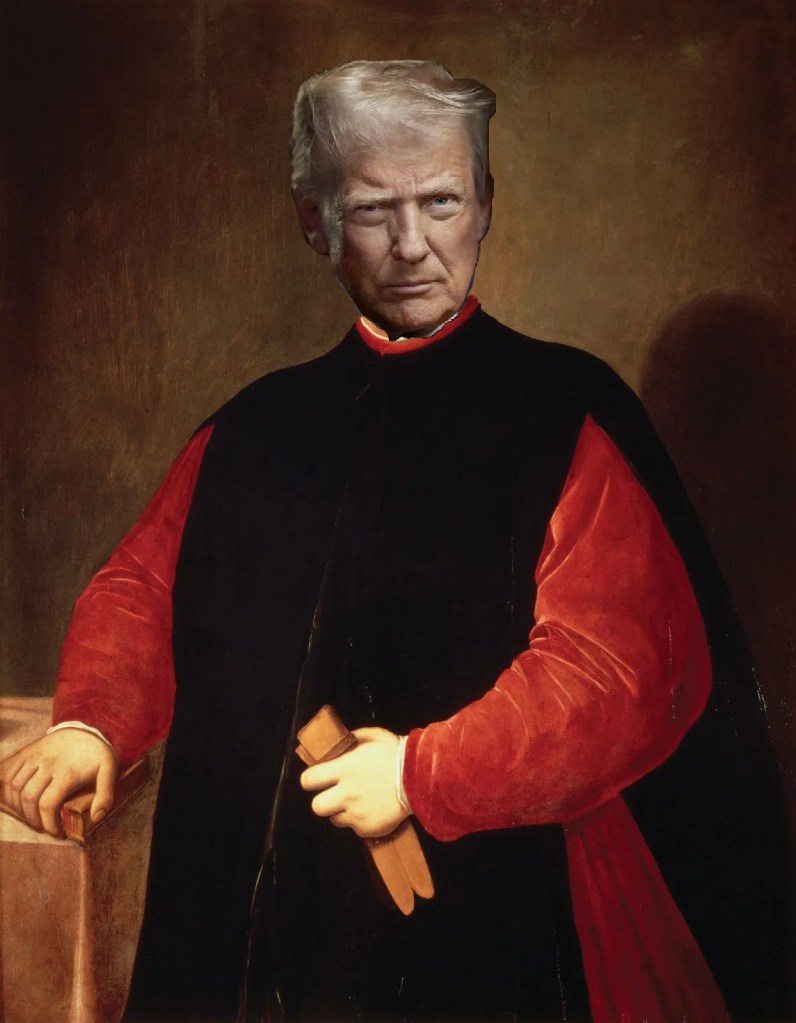
This is part of a larger series I am working on.
While recently rereading Machiavelli’s The Prince, I couldn’t help but compare and contrast his advice to the past year of the Trump administration. Machiavelli specifically wrote The Prince excluding republics, but the book still seems apt because the U.S. president, especially since the 1930’s, acts more as an elected king than simple presider over the executive branch.
On top of this, the Trump administration has an especially expansive view of the imperial presidency, arguing a “unitary executive” theory of presidential power. The administration in general, and the president specifically, also embraces a tough guy tell-it-like-it-is I’m the boss attitude that makes it somewhat unique compared to the other forty-six presidential administrations, including Trump 1.0.
So, given the Trump administration would seem to embrace a Machiavellian approach to government, how would Machiavelli grade the first year of the administration based on his seminal work, The Prince?
Machiavelli begins his discussion by looking at the types of principalities that exist and what to do when you first acquire power in them. Since these are all some flavor of one-man rule, he differentiates the types of principalities based on how the leader came into possession of them. First is a principality gained through hereditary succession, and Machiavelli’s advice is simple: don’t change anything. If the system worked well enough to get the state from father to son (and lets be real, he’s not talking about women) the worst thing a new leader can do is start changing things up and turning people against you right away.
This is in contrast to what he calls a “mixed principality”, one where you had an existing principality and you have acquired a new one by conquest or some other means. This is probably the best parallel for Trump 2.0. In Trump’s first term, he certainly had supporters all around the country, but there was still robust Never Trump Republican holdouts in state and local offices as well. By Trump 2.0, he and his family had much tighter control of the national Republican Party, and his supporters had spent nearly eight years gaining elected offices, political appointments, and judgeships, especially in deeply red states. Machiavelli would describe this as a clear base of support, or principality, from which the Trump administration was now trying to take control of more blue areas.
Machiavelli argues that mixed principalities are the hardest to handle. By definition, a large group of the population doesn’t want you there, that’s why they opposed you, and you have a lot of promises to keep to those that supported you and are going to expect you to live up to those promises. If you don’t quickly move to give your supporters what you promised, they will, in the best case, be apathetic about helping you further, and worst case join the cause against you. Given the Trump campaign’s focus on the economy, cost of living, and affordability, this is a glaring weakness of Trump’s first year. Polls indicated the economy as the number one issue for voters during the presidential campaign, and his downplaying of it now suggests that Machiavelli would have a few rude things to say to Treasury Secretary Scott Bessent and others.
Machiavelli also emphasizes time and again that if you must do anything illegal or that you know will be disliked, that’s fine, this is the real world, BUT you should do them as fast as possible at the beginning of your reign and then quickly back off and adopt a more conciliatory tone. He contends that people are more willing to forget short sharp abuses than they are a constant drip of pain and transgressions.
Project 2025 and numerous Trump World influencers would, at first glance, seem to have been astute students of Machiavelli. The administration came in with a plan, moved out swiftly across the apparatus of government, and put any effective opposition on its back heels. However, in many ways the efforts also just as quickly started to drag out, as the administration’s operatives received conflicting guidance from a second “Prince” in the form of Elon Musk and a lack of clear guidance from Trump himself on what HIS priorities were and not just what some random conservative think tankers focused on their hobbyhorse issues were. Government control reforms became conflated with cuts to federal overhead, which became confused with the deified idol of deregulation, and any attempt by the administration to “destroy the administrative state” petered out and made the administration look weak.
An even more glaring failure has been the administration’s efforts at mass deportation. Despite its big talk about Day One actions, like Machiavelli would recommend, it quickly ran into the reality that you cannot simply raise an entire internal army overnight and that, while many Trump supporters might have wanted “illegals” out of their country, those individuals had no intention of leaving their day jobs to go hunt down the dangerous savages the administration assured them lurked around every corner.
Compounding the problem was that there really wasn’t the mass of violent criminal immigrants that the administration talked up during the campaign. This has meant that hitting the deportation quota numbers the administration promised has required costly military and paramilitary deployments, not only to find anyone that can be deported but also to “protect” the deporters from an increasingly mobilized opposition, emboldened by the administration’s evermore unpopular actions. This has arguably been the administration’s most glaring defeat and resulted in the greatest drop in its support. All of which, Machiavelli would argue, could have been prevented by not letting your mouth write checks your administration couldn’t cash. Machiavelli was okay with lying, but you need to know you’re lying and have a plan for what you’re actually going to do when the lie is found out.
With the prince successfully in power, Machiavelli next moves on to describing how the prince should go about securing his principality. Under no circumstances should mercenaries be used, and by this Machiavelli means troops that are not your own and are not completely loyal to you. Further, a prince should, “have no other object or thought, nor take anything as his art save warfare and its institutions and training.”
By Machiavelli’s judgement, the Trump administration would be a failure on both counts. Upon taking control it did take some limited actions against commanders it thought might be “disloyal” but these were largely limited to complaints over “DEI” and various other “conservative” talking points. Despite a lot of bluster, and an infamous meeting of all of the military’s senior leaders in a Marine Corps base near the capital, the administration has never had the cojones to actually try to install a personalist regime in control of the military. And, despite the fears of many Americans and a massive budget, the paramilitary forces the administration has attempted to raise have fallen well short of their recruiting quotas and have neither the institutional knowledge nor logistical underpinning to carry out successful counterinsurgency operations against the populace.
Part of the challenge for installing a personalist regime atop the actual United States military is its foundational institutional history and ethos in protecting the republic and the republic’s constitution. Any purge of the military’s leadership would need to be so invasive that it would cripple the capabilities of the organization and render the new monster dead in the womb.
Machiavelli would argue that the failure to understand this stems from the top, as Trump is clearly uninterested in engaging seriously in matters of national security and military affairs. Vanity projects like the Golden Dome, fixations on steam-powered catapults, and now an entire “Golden Fleet” of “battleships” named after himself, are only the beginning of an inability to comprehend the service and servant-leadership ethos of modern western militaries, and especially the United States’.
It is in the concluding section of The Prince that we get Machiavelli’s famous commentary on whether it is better to be loved or feared. He argues that love will often get you nowhere, in part because it makes it easier for people to cross you if they only love you. After all, husbands love their spouses and still cheat on them, taking advantage of the fact that they are loved in return and that that will mean they will be forgiven. [Author’s note to spouse: I’m speaking for Machiavelli here, not saying I agree 😂] No, for Machiavelli, it is better to be feared, BUT not so much that you become hated.
To avoid contempt and hatred, don’t take people’s money and threaten people’s livelihoods. Don’t seem changeable, light, or irresolute. If people believe you can be manipulated (and especially if you can) they will think you are weak, despise you, and conspire to manipulate you. Don’t drift too far from the public sentiment of your people because that will protect you from conspirators, who fear they will have to deal with an angry populace if they actually do overthrow you.
On all these suggestions, the Trump administration gets an “F” from Machiavelli. Take for example Trump’s tariff policy. It taxes (despite his assertions to the contrary) hundreds of millions of Americans just for going about their daily lives. The tariffs have also upended American business planning and caused layoffs. It’s also completely obvious that personal appeals to Trump himself, much less some sort of bribe, help certain firms or industries avoid the worst of the import taxes. This only encourages disaffection, increases contempt for the administration, and puts Trump further at odds with the public. This aides his political opponents, and, indeed, to the extent the Democratic Party is viewed negatively in public polling, drilldown data suggests the Democrats are loathed by the public because they are not MORE against Trump rather than because they oppose him.
None of the above is to suggest that the administration has not had a long-term impact on the American republic and society. However, Machiavelli would argue that it would have been able to have had a more effective impact or made it harder to prevent the reversal of their efforts, if they had more thoroughly read his book. The administration comes off as a student that only skimmed the CliffsNotes version, vaguely aware of the tough guy talk but who skipped the parts about throwing in a few carrots after all those sticks.
One would hope that whatever administration comes next will study Machiavelli’s work more thoroughly. They will not be dealing with a regular presidential transition. If it is a Republican administration, they will not be able to rely on Machiavelli’s advice for hereditary succession and just leave everything alone; they would be well advised to change things. If it is a Democratic administration, it will need to be even more prepared. The worse they will face will not just be the cheeky removal of all of the “W’s” from the White House keyboards like the Clinton administration did to George Bush’s staff. The next administration might come from a world of good intentions, but it will need to be ready to play power politics, just like ol’ Niccolò di Bernardo dei Machiavelli would recommend.
 The History Doctor
Leave a comment