
This is part of a larger project I am working on. These are just raw reactions to the text as I read it. For the final discussion, check out my Substack.
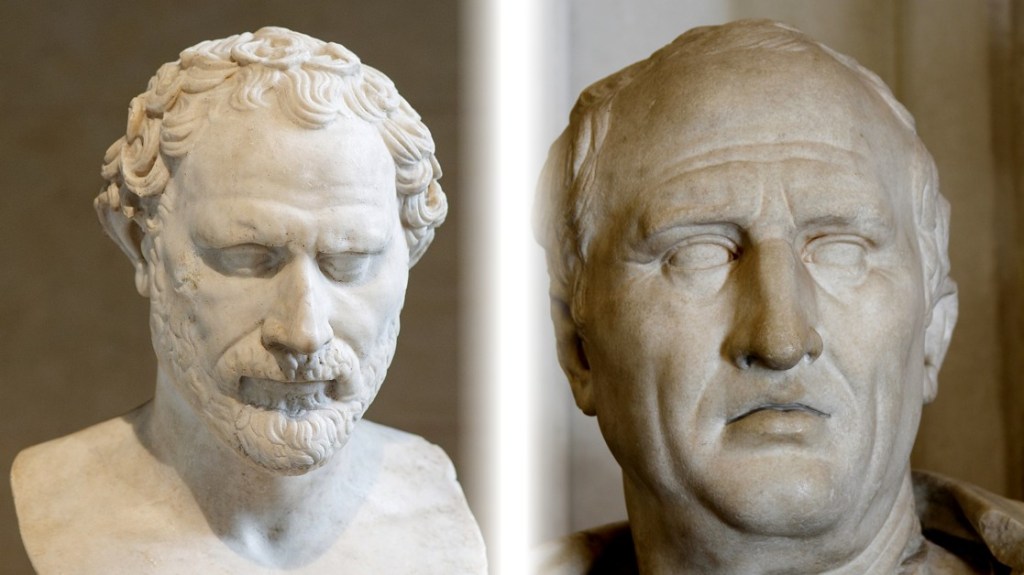
Both Demosthenes and Cicero were well-intentioned statemen that failed to control the swirling events around them.
Demosthenes was born in Athens following its defeat in the Peloponnesian War. He became an accomplished orator and rhetorician, his first goal being to take his legal guardians to court once he came of age because they had been misappropriating the money left for his upbringing. The Athenian equivalent of a lawyer, he offered legal assistance and accompanying oral arguments for clients. He quickly developed an interest in crafting the law and not just arguing about it.
Most of his political activity were oratories against Phillip II, King of Macedon. Demosthenes worried about the growing Macedonian influence in the Greek world. He wanted to see Athens rise from the ashes of the Peloponnesian War and lead a Panhellenic alliance against the upstart barbarians from the north that pretended to be proper Greeks.
His efforts were inhibited by the willingness of more oligarchic cities in the Peloponnese to side with Phillip. In these cities, with more concentrated wealth and more powerful elites, they cared less about who was in charge as long as their positions and privileges in society were not effected.
Phillip grew tired of Athens and its noisy citizen Demosthenes and finally invaded southern Greece. Athens assembled an alliance of various Boeotian and Attican cities and fought Phillip on the plains of Chaeronea, where they lost. Phillip punished Thebes harshly but spared Athens, trying to give examples of carrots and sticks. Alexander followed a similar policy when Greece rebelled following the death of his followers, but, this time, Alexander demanded all anti-Macedonians expelled from the city, forcing Demosthenes into exile.
When Alexander died, Demosthenes encouraged a Greek uprising against the Macedonians, but it was quickly put down by Antipater, the local warlord of the Alexandrian successors. He killed himself before he could be captured by Macedonian forces, still trying to find a way for Athenian, and Greek, independence.
Cicero was also an accomplished orator and jurist. The son of an upper-middle class Roman family, he was a true believer in the Roman republic and passionate lover of Hellenistic philosophy.
He was consul during the Catalinarian conspiracy and helped thwart the overthrow of the republic, but he was criticized for his harsh methods in putting it down, including the summary execution of five of the conspirators. Following that, he decided to take positions outside of Rome for a number of years.
He returned just as the standoff between Caesar and Pompey was beginning. He backed Pompey in the civil war that followed, but, like Cato, began to wonder if they had made a mistake by opposing Caesar so harshly and not giving him a route through which he could backdown but also save face. Caesar eventually pardoned Cicero and he moved back to Rome.
After Caesar’s assassination by Brutus and others, Cicero opposed Antony and even helped put forward Octavian, the future Emperor Augustus, as a political opponent to Antony’s excesses. However, when Antony and Octavian formed the Second Triumvirate with Lepidus, Cicero was left out in the cold. He attempted to flee Rome, but was caught by Antony’s forces and his hands and head were removed from his body and displayed on the rostra of the senate as a warning to the other senators.
Demosthenes and Cicero both wanted what was best for their cities and believed strongly in principled governance. Both were also, unfortunately, born at times when morals and values were increasingly set by the wayside as raw power outweighed principles.
If you’re interested in the final discussion of the book, check out my Substack.
 The History Doctor
Leave a comment