
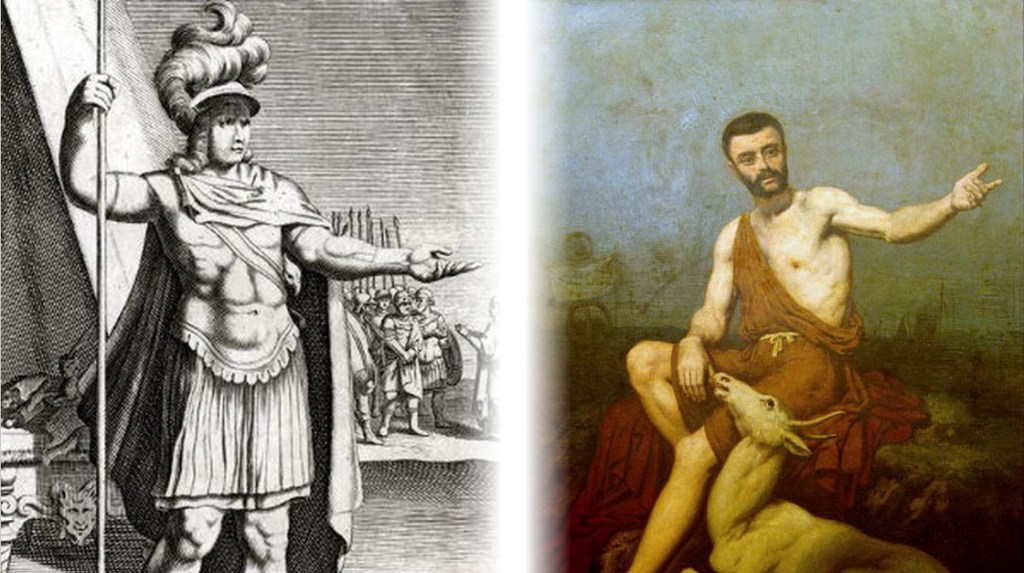
This is part of a larger project I am working on. These are just raw reactions to the text as I read it. For the final discussion, check out my Substack.
Eumenes and Sertorius are great examples of skilled military leaders that did not have the material and personnel advantages of a Caesar or Alexander. They had to struggle through adverse conditions and find a way to win while lacking in resources.
Eumenes was the royal secretary to Alexander the Great but was not of Macedonian birth. He was reportedly extremely loyal to the royal family but his proximity to the crown was often resented by the Macedonian generals that served under Alexander as combat leaders.
When Alexander died without leaving a clear successor, Eumenes played up his Cardian heritage as a way to argue he was disinterested in the Macedonian question of who would ascend to the throne. He tried to negotiate peace between the various parties, but in siding with no one, seems to have become a suspected enemy of everyone.
In the Partition of Babylon, Eumenes recieved the satrap of Cappadocia and Paphlagonia in eastern Anatolia. However, they areas were in open rebellion against Alexander’s successors, and Eumenes had to subdue them before he could take command.
He became embroiled in the various successor wars that followed Alexander’s death and was a successful general in the conflicts. However, his not being a Macedonian became more and more of an issue as Macedonian-born generals came to resent the idea of an outsider doing so well. They used this an excuse to knock him out of their alliance and revoked his satrap, excommunicating him and declaring war.
He was an outlaw, but he used his skills and the resources at hand to conduct a long series of attacks on the other Successor generals. He fought throughout western Asia, from the mountains near Armenia to the desserts of southern Syria. He defeated a long series of armies that tried to run him and his forces down. He lacked any sort of center of power or base of operations. This meant that he was free to constantly stay on the attack in his enemies country, but it also meant he had no area where he could seriously rest and refit his forces, or even stop fighting and negotiate a peace from.
Eventually, Eumenes was betrayed by his own men, his opponents reaching out to them to try and do by subterfuge what they had never been able to do on the battlefield. In exchange for an end to their constant campaigning, his soldiers surrendered him to his enemies, who killed him.
Like Eumenes, Sertorius lived the life of an outlaw general. Sertorius had served Marius during the Celtic invasion of Italy. During that conflict, Sertorius went “behind the lines” numerous times on scouting missions into Gallic territory and became adept at adapting to other cultures.
When the civil war broke out between Marius and Sulla, Sertorius sided with his old commander. Unlike Marius and other Marian officers, Sertorius seems not to have taken part in the political purges and war crimes that marked Marius’ dictatorship. However, he fled Italy, nonetheless, when Sulla’s forces took over.
He went first to Spain, where he set himself up as governor, leading an insurrection against Sulla. Forces under Sulla’s command drove Sertorius out and forced him into Africa. He allied himself with a local leader in Mauritania [modern Morocco] and tried to keep his army together by assisting the locals.
The Lusitanians [one of the native Spanish tribes] asked him to return to Spain and help fight against the Romans. He accepted and led a guerilla campaign that drove back Roman power almost completely out of the Iberian Peninsula. Eventually, the Senate sent Pompey to Spain to try and stabilize the situation and deal with the incessant hit and run attacks that were weakening Roman power in the western Mediterranean.
Sertorius bested Pompey in numerous battles and forced him back. With Rome looking exceedingly weak, Mithridates, King of Pontus in eastern Anatolia, wrote to Sertorius proposing an alliance. Sertorius should keep the fight up against Rome in the west, while Mithridates engaged in the east. Together, they would so weaken the government in Rome that Sertorius would be free to march on the city and drive out the people that had persecuted him politically.
Sertorius agreed and promoted the deal to the exiled senators in his camp that had also fled Sulla’s forces. A cabal of those senators, seeing their faction on the rise, but wanting to be the leaders of the final march to victory, killed Sertorius. They were later defeated by Pompey and killed.
Both Eumenes and Sertorius had to lead armies that did not have substantial logistical advantages and conduct asymmetric operations against larger, more organized forces. Eumenes did so by cutting free of any supply lines and “living off the land” of his opponents. By keeping his army on the move, he could avoid being tied down to any one place, but it did mean he had to keep moving and keep fighting. From an operational perspective it was the right idea, but, strategically, it could only be carried on for so long.
Sertorius conducted a lengthy hit and run campaign that took advantage of the mountainous terrain of Spain. His opponents would remark that they never knew how many soldiers they would have to contend with in any fight against him. Was he leading a raid with a few hundred or fighting a battle with tens of thousands? He kept Spain in a constant state of alarm and made supplying the occupying heavy infantry legions exceedingly difficult, forcing them to shorten their supply lines to the Mediterranean coast or Pyrenees Mountains.
Both of these generals provide interesting early examples of asymmetric strategies that weaker forces used to successfully prosecute military campaigns against larger more powerful opponents.
If you’re interested in the final discussion of the book, check out my Substack.
 The History Doctor
Leave a comment