
This is part of a larger project I am working on. These are just raw reactions to the text as I read it. For the final discussion, check out my Substack.
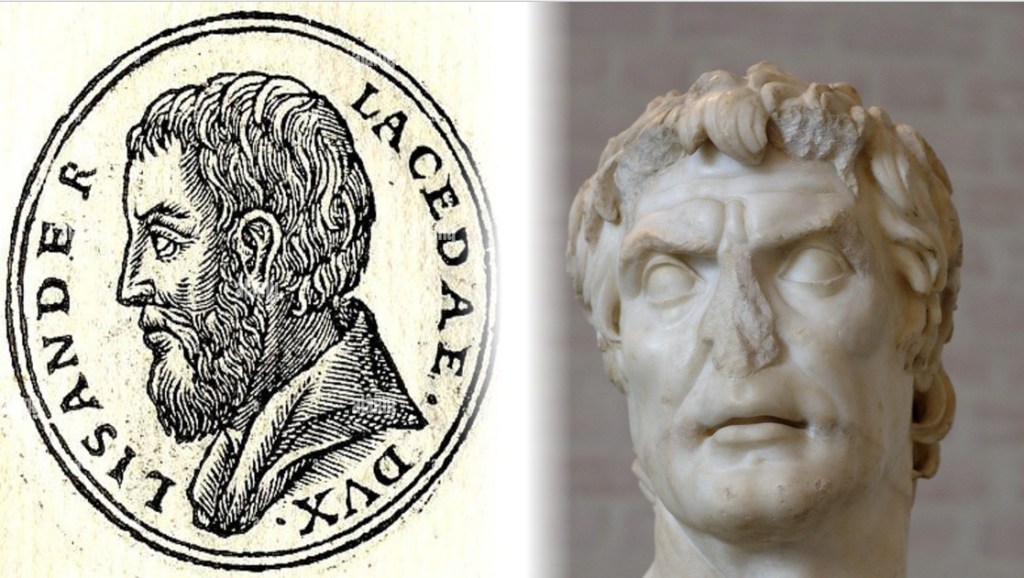
Lysander and Sulla were domineering figures that, while successful military leaders, were disasters in the political realm, failing to understand the differences between those two spheres.
Lysander was a Spartan commander who served in the later stages of the Peloponnesian War. The Spartan leadership sent him east into the Aegean to contest Alcibiades and his attempts at rehabilitating the Athenian empire after its disastrous Sicilian campaign. He contested the Athenians first at Notium, then at Aegospotami, where he destroyed almost the entire Athenian navy, breaking the back of Athens’ empire.
He slowly drove the Athenians back into their city, trying to force as many mouths as possible behind the walls he intended to besiege. He then forced its surrender, tore down its protective walls, and installed an oligarchy to control the city as Sparta directed.
During these operations, he became frequently enmeshed in Persian court politics, lying and scheming his way into advantages for Sparta in general, but himself personally. As he rolled back Athenian power, he also installed oligarchic governments throughout the Greek world, governments that would look to Sparta, and him, for direction. He had a vision for a Spartiate empire that could rule as Athens had.
However, neither the other Greeks, nor even most of the Spartans, approved of this plan. Many Spartans had become concerned about the corrupting influences of money and foreign ideas. Many Greeks detested the Laconic lifestyle imposed on them by Lysander’s oligarchic friends, and resented exchanging one imperial master for another. He died trying to put down rebellions against Spartan power.
Like Lysander, Sulla was a schemer. Born into relative poverty, he worked his way up the patrician ranks thanks to the army. He served alongside Marius in north Africa following the Third Punic War. He was famously involved in the capture of the enemy king, Jugurtha, and fought with Marius the rest of their lives about who had been more responsible for the operation.
Sulla’s sense of aggrievement only grew as he found more success, no accolades ever being good enough for what he felt he was owed. He got involved in Roman politics and, somewhat ironically, tended to favor the senate over the people, despite his humbler origins. This was because his more Patrician opponent, Marius, had already cornered the market on playing to the cheap seats, so Sulla was brought in as a hired gun by the Senate, though they never really accepted him as one of their own class.
The contest between Sulla and Marius nearly boiled over into civil war, but an Italian uprising temporarily put a pause to the contest. In the Social War, Sulla gained the majority of the military honors, Marius’ age beginning to show.
When a new war broke out against the Asian king Mithradates, Sulla expected to be made general and lead the operation, but Marius used his influence to secure the position. However, Sulla refused, took control of the army and government, and forced Marius into exile.
While Sulla was away fighting in Greece and Thrace, Marius reentered Rome, purged some of Sulla’s supporters, and tried to consolidate his position. However, Sulla quickly organized a truce in Asia and raced his army back to Italy. Along with his officers, and future fellow schemers, Crassus and Pompey, Sulla fought a civil war against various political opponents and made himself dictator.
He enacted some reforms of Rome’s constitution to try and give more power back to the senate and away from the tribunes of the people. He died of natural causes after laying down his dictatorship, but the precedent had been set, and the Roman republic was on its deathbed as a system of government.
Lysander and Sulla may have been good battlefield generals but they did not understand, or did not care, about the political context of the governments they served as military officers. Both violated the constitutions they ostensibly protected in the name of power and self-aggrandizement fueled by personal grievance.
If you’re interested in the final discussion of the book, check out my Substack.
 The History Doctor
Leave a comment