
This is part of a larger project I am working on. These are just raw reactions to the text as I read it. For the final discussion, check out my Substack.
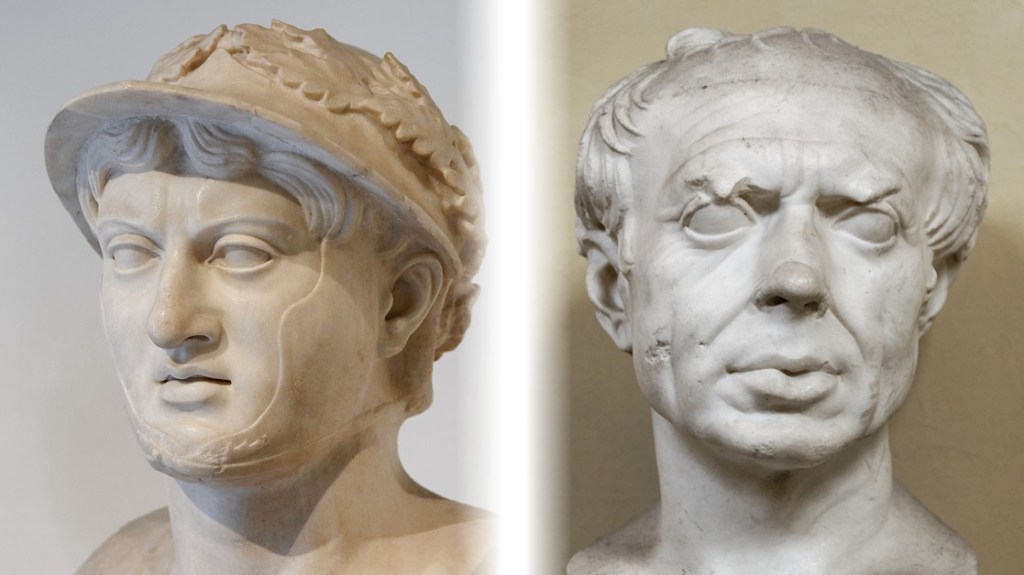
Pyrrhus of Epirus and Gaius Marius of Rome were two accomplished generals. Their success came from a willingness to take risks and seek battle to an extent many of their peers would not. Their downfall came from a willingness to take risks and seek battle in a way that was disconnected from larger political goals or a fleshed-out concept of victory.
Pyrrhus served under Alexander the Great during his famous campaigns in Persia. After Alexander’s death, Pyrrhus was a regional warlord in Epirus, on the eastern coast of the Adriatic. He fought constantly with the other Successor State kings and was briefly King of Macedon himself.
Famous for his military skill, the Greeks living in southern Italy asked Pyrrhus to intervene on their behalf as they came under increasing pressure from an expansionist Roman republic driving south from central Italy. He crossed the Adriatic with his forces and proceeded to engage the Roman army in a series of battles. Many of them were near run affairs where, though he won, he said himself he would not be able to survive many such victories. He failed to knock the Romans out of the war because of the fundamental differences between the Roman army and its warrior society peers, most notably Rome’s ability to raise replacement armies faster because their forces drew from a broader portion of the population than their opponents.
Getting nowhere in Italy but with Rome briefly busy building up a new force, Pyrrhus traveled to Sicily to assist the Greeks there in a fight against the Carthaginians. He was successful in defeating the Carthaginians for a time, but when it became clear his next goal was to callously use Sicilian resources for his own personal invasion of Carthage proper, the Sicilians revolted against him. He crossed back to Italy, lost again to the Romans, and then went back to Epirus and began operations against the Macedonians and then the Greeks, always looking for some new way to expand his personal empire and power, a miniature version of his hero Alexander.
Marius also apprenticed under a famous war leader, in his case Scipio Africanus, in his invasion of Carthage. He later fought against the north African leader Jugurtha, whose defeat and capture became a point of dispute between Marius and his fellow Roman Sulla.
The Roman people elected Marius consul during an expected invasion of Italy by the Cimbrii and Teutones, two Germanic or Celtic tribes migrating south. He conducted a series of reforms to the Roman army to prepare for the invasion and lead a spoiling attack into what is now southern Frace to try and avoid fighting in Italian territory.
When not at war, he played to the common people of Rome, using the Patrician class a foil with which he could build political power. The senators backed Sulla as someone that could oppose Marius’ popularity. This dispute nearly boiled over into civil war, but a conflict between Rome and its nominal Italian allies on the peninsula staved off the worst. In this conflict, Sulla earned more of the plaudits, in part because Marius may have been getting too old to lead a force in the field.
Addicted to the attention military campaigning provided, Marius lobbied to lead the army when a new threat emerged in Asia, however Sulla refused to relinquish control of his forces, and Marius fled Rome into exile lest he be captured and executed by Sulla as his primary political opponent.
In North Africa, Marius raised a small force and crossed back into Italy, allying himself with one of the two disputing consuls while Sulla was away. Marius launched into a vengeful series of political murders throughout the capital, but when it became clear that Sulla would soon return with a large veteran army before Marius could fully consolidate power, Marius drank himself to death.
With Pyrrhus and Marius, we find two generals addicted to battle who were masterful operational and tactical leaders, but who could not articulate or execute towards any coherent concept of victory, all they knew how to do was fight. That limited conceptual framework of what battle and military operations were for undermined Pyrrhus’ personal rule of his dominions and, in the case of Marius, helped begin the political turmoil that would result in the death of the Roman republic and usher in autocratic tyrannical rule.
If you’re interested in the final discussion of the book, check out my Substack.
 The History Doctor
Leave a comment