
This is part of a larger project I am working on. These are just raw reactions to the text as I read it. For the final discussion, check out my Substack.
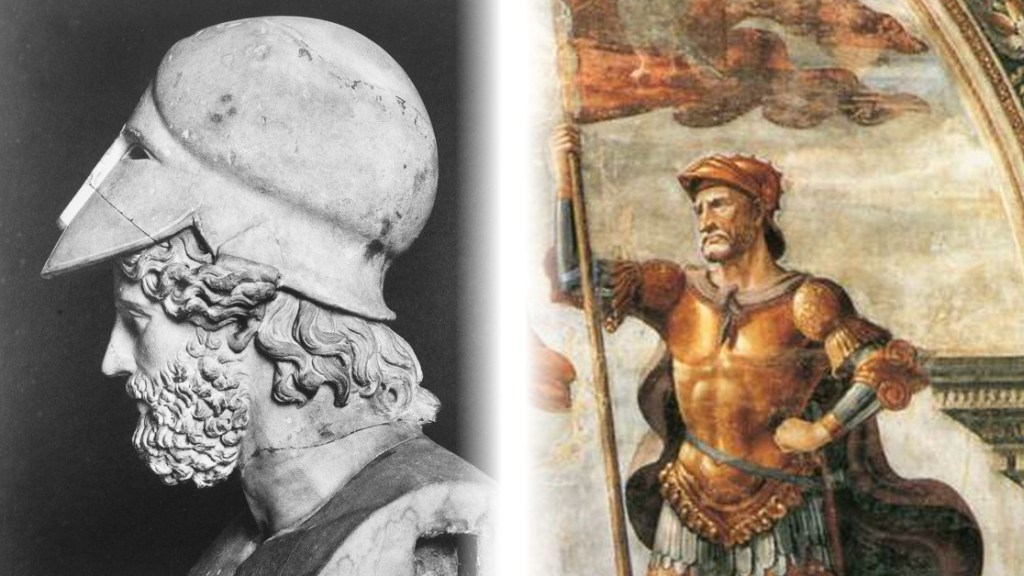
Themistocles and Camilus were two Greek and Roman military leaders that understood there were more ways to win a fight than simply being big and strong.
Themistocles was an Athenian, and in many ways the father of its navy. He encouraged the city to use its access to silver mines to finance the construction of a fleet, arguing that this sort of investment would pay dividends for Athens later. The Persian invasion of Greece proved his foresight correct.
Themistocles led the Athenian defense against the Persians. He took the fleet north and screened Leonidas and his Three Hundred while they fought the Battle of Thermopylae, but the Spartans lost, and Themistocles had to retreat. However, he did so slowly, harassing the Persians as they marched along the Aegean coast. He also wrote disconcerting messages in Greek to the Persian’s Greek allies on the rock faces they marched past. The idea was to undermine the morale of the Greek soldiers forced to serve the Persians, as well as make the Persians distrust the Greeks in their service.
Themistocles encouraged the Athenians to abandon Athens itself once it became clear the Peloponnesians would not fight on Attican soil. They instead planned to defend the isthmus that connected the Peloponnese to Attica. From a land-based approach it made sense, the position was narrow and easily fortifiable. Themistocles was more of an admiral than a general and realized that if the Persians maintained their naval supremacy, it did not matter if the Spartans held the isthmus, the Persians could simply sail past them and encircle their position. Consequently, Themistocles planned to use the Athenian fleet to attack the Persians in the narrow straits of Salamis.
The Persian king Xerxes watched helplessly from a throne positioned on the heights above the strait as the Athenians annihilated his fleet. Themistocles and the Athenians fed a rumor to Xerxes that they planned to strike north and destroy his bridge over the Bosphorus and cut off his line of retreat and supply to Asia. They had no intention of doing so but the threat of this caused Xerxes to turn around and cancel any further invasion of Greece.
Like Themistocles, Camilus understood lines of supply, even if he would not have phrased it that way. He was a Roman general elected multiple times to serve as dictator during various attacks on Rome. The most famous and important was the invasion by the Gauls that resulted in the sack of Rome itself early in its history.
Camillus was outside the city when the Gauls captured Rome. He organized the disparate troops available to him into raiding forces that harassed the Gauls foraging in the Roman countryside trying to find food for their large army. Camillus created a desperate situation for the Gauls where the size of their army became a liability and its biggest weakness. He so attrited the Gallic force that the Romans were eventually able to defeat it in battle and free Rome.
Following the sack of Rome, her neighboring enemies sprung on her, smelling weakness. Camillus used mobility to overcome superior numbers regularly launching strikes behind his opponents to cut off and harass their lines of supply, forcing them to fall back without risking a major engagement.
Both Themistocles and Camillus are interesting examples of early military leaders that did not follow the Spartan model of line up your troops and see who is stronger. Both managed to use mobility to overcome superior numbers. And both found ways to make the size of the opponent work against them.
If you’re interested in the final discussion of the book, check out my Substack.
 The History Doctor
Leave a comment